Diabetic retinopathy occurs when the small blood vessels supplying oxygen and nutrients to the retina become damaged by diabetes.
Mild diabetic retinopathy may not require active treatment and can be monitored.
Severe diabetic retinopathy can lead to bleeding, retinal detachment and loss of vision.
Everyone with diabetes should have their eyes examined regularly.
Treatment for diabetic retinopathy can include laser, injections of medication into the eye and retinal surgery.
Epiretinal Membrane
Epiretinal membrane is comprised of scar tissue that forms on the central part of the retina called the macula.
It can occur with increasing age and can also be caused by inflammation, diabetes or trauma.
Common symptoms include blurred vision and distortion. Lines may appear disjointed and letters in a word may be missing.
Epiretinal membrane can be removed with day surgery to improve symptoms.
Floaters (Vitreous Opacities)
Floaters are small solid bits of jelly that float around the back of the eye.
Patients with floaters often describe floating dots, spider webs or insects moving across their vision.
Floaters normally get better with observation however they can be removed with day surgery if persistent and bothersome.
Inherited Retinal Disease
Retinal problems are sometimes inherited and caused by a faulty gene.
Sometimes more than one family member may have similar problems with their vision such as central or peripheral vision loss or difficulty seeing at night.
Genetic testing and occasionally gene therapy is available for people who have an inherited retinal disease.
Macular Degeneration
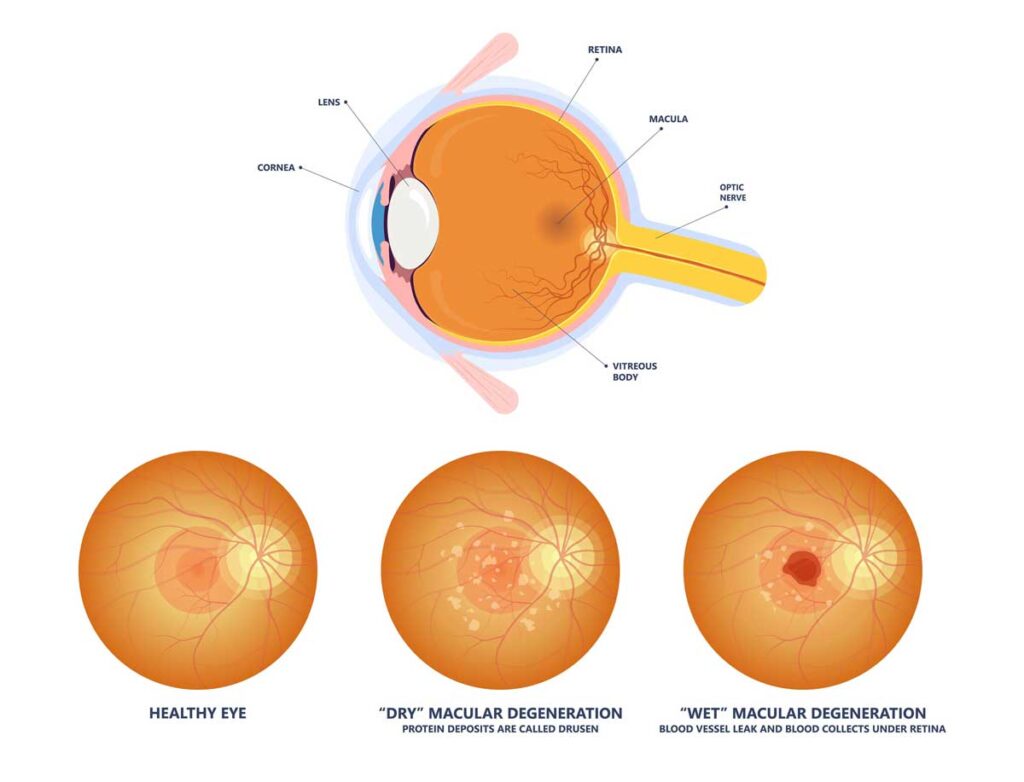
Age-related macular degeneration (AMD) occurs in patients above the age of 60 years and can be either dry or wet.
Dry Macular Degeneration (Dry AMD) leads to progressive loss of central vision.
Although there is no current treatment for Dry AMD, research into gene therapy and stem cell therapy for this condition is underway.
Patients with Dry AMD are advised to avoid smoking and to eat a healthy diet including fish and vegetables.
Patients with Dry AMD should use an Amsler Grid at least once per week to monitor for any progression to Wet Macular Degeneration.
Wet Macular Degeneration (Wet AMD) is a serious condition that can cause sudden loss of vision due to a build up of fluid at the central part of the retina called the macula.
Common symptoms include an often rapidly progressive blurring of vision or distortion of central vision which can be identified at an early stage when monitoring Dry AMD with an Amsler Grid.
Vision loss associated with Wet AMD can often be reduced or possibly reversed with regular injections of medication into the eye.
MaculaR Hole
Macular hole can occur when the vitreous (jelly) pulls on the central part of the retina called the macula.
Traction on the macula can lead to a full-thickness macular hole.
Common symptoms include blurred vision and distortion where lines can appear disjointed or letters in a word are missing.
Macular hole is a serious condition that usually requires day surgery to prevent further loss of vision.
Retinal Detachment
Retinal detachment occurs when fluid leaks under the retina following a retinal tear.
Common symptoms include flashing lights, floaters, and peripheral followed by central vision loss.
Retinal detachment is an emergency and usually requires urgent diagnosis and surgery.
Untreated, a retinal detachment can lead to permanent blindness.
Retinal Tears (Flashes + Floaters)
Retinal tears occur when the vitreous (jelly) at the back of the eye pulls on the retina.
Symptoms usually include flashing lights and floaters.
Left untreated, retinal tears can progress to retinal detachment.
If identified at an early stage, retinal tears can be safely treated with a laser procedure in clinic.
Vitreomacular Traction
Vitreomacular traction can occur when the vitreous (jelly) pulls on the macula.
Symptoms usually include blurred vision and distortion.
Vitreomacular traction can either self-resolve or can progress to form a macular hole.
Treatment normally involves monitoring if the patient is asymptomatic or surgery if symptoms are bothersome.